Epoxy Floor Repair & Recoating in Nairobi
Repairs & recoats
Survey, strip, rebuild, re-lay · nothing new goes on until the old floor is pull-tested
Kitui Road
Failed coating, 1,200 m²
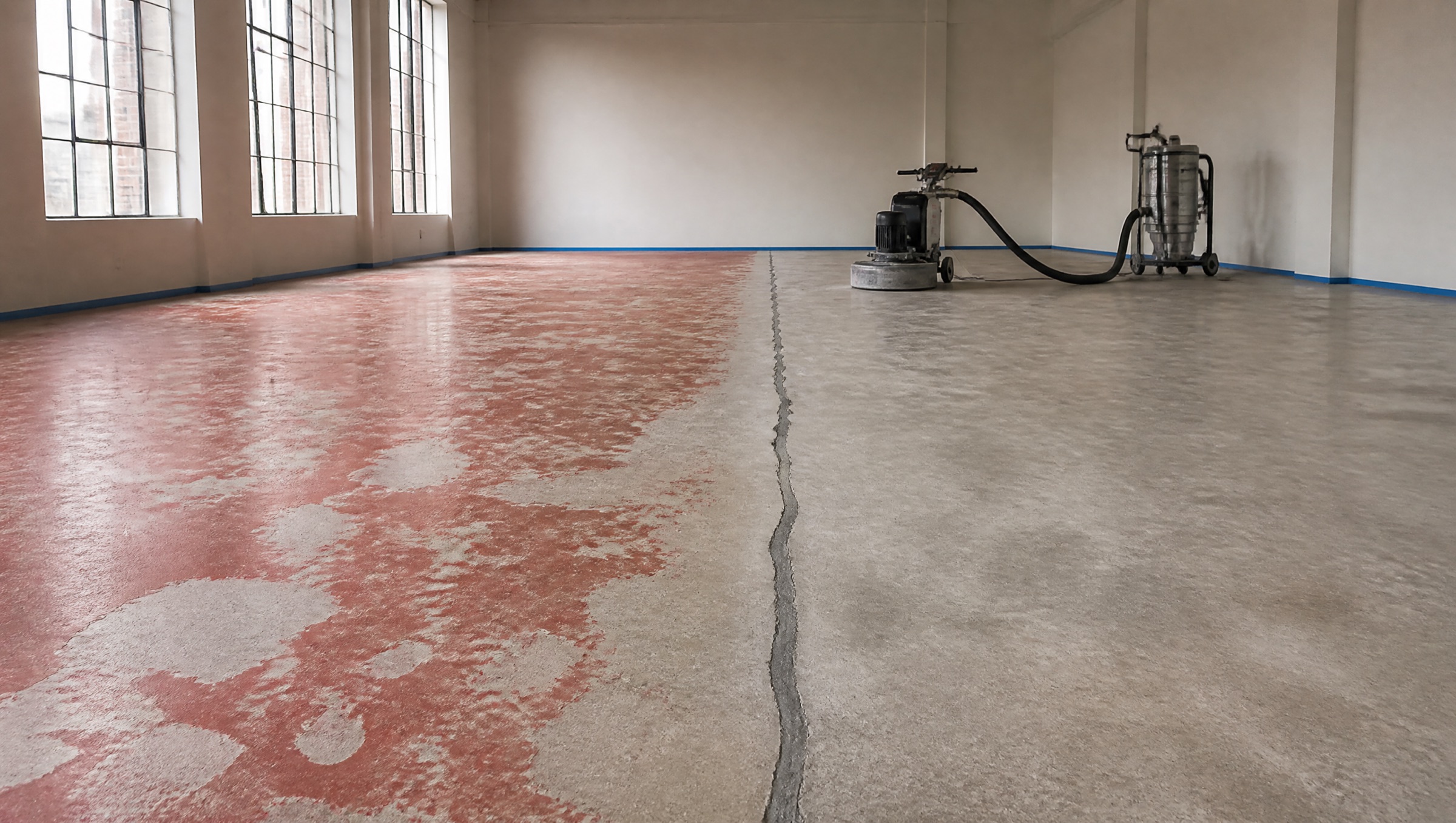
About a third of the floors we lay are second attempts. Someone else coated the slab, it lifted, bubbled, peeled or powdered, and the client is now being told the whole thing has to come up. Sometimes that is true. Often it is not, but you cannot know which until you find out why the first floor failed, and that is the entire job here. Across Nairobi and Kiambu that means cracked slabs, spalling and peeling DIY coatings, and every one starts with a pull test.
A resin floor fails in a small number of ways, and they leave different evidence. Vapour from an untested slab lifts a coating in domed blisters with clean concrete underneath. Poor mechanical prep peels it away in sheets that come off with the print of a smooth slab on the back. Bad mixing leaves soft, tacky patches that never hardened. A missed recoat window shows as one clear layer sliding off another. We read the floor before we quote it.
The tests that decide the quote
Moisture first: internal relative humidity at 40 % of slab depth, tested to ASTM F2170, because it predicts what the slab will do rather than what it is doing this morning. A standard system wants 75 % RH or less; a moisture-tolerant primer carries to about 85 %; above that the system changes.
Then adhesion. We pull-test the existing coating in a grid across the floor. Sound bond comes back at 1.5 MPa or better and can usually be kept, prepared and overcoated for a fraction of the cost of a strip-out. Anything below that is not a floor, it is a liability with a gloss on it, and it comes off.
What gets rebuilt before anything new is laid
Cracks are chased out into a V, filled with rigid epoxy mortar and ground flush, and where a crack is still live, it is stitched across rather than simply filled, because a moving crack will telegraph through anything you put on top of it.
Spalled areas, broken joint arrises, ponding hollows and the trench left by a removed machine base all get rebuilt in mortar and levelled back to plane. Only then does the new system go down: usually flake (02) in a workshop, quartz (04) in a kitchen, mortar screed (05) in a plant. We do not have one answer, we have the one the slab asks for.
Where this system belongs
Specified for
- Peeling, blistering or powdering coatings: diagnosed first, so the second floor does not fail the way the first one did.
- Cracked, spalled and patched slabs: chased, stitched, rebuilt in epoxy mortar and ground back to plane.
- Tired floors that are still sound: if the bond passes the pull test, a prepare-and-recoat is a fraction of a strip-out.
Not specified for
- A cosmetic coat over a failing floor: if the bond fails the test we will not put a new system on it, whatever the budget says.
- Structural concrete repair: broken-up, settling or reinforced-failure slabs need a structural engineer before they need us.
- Same system, same conditions: if the cause was vapour, relaying the same build-up just buys another two years.
- Pull-off min.
- 1.5 MPa
- Moisture test
- ASTM F2170
- Standard limit
- 75 % RH
- Tolerant primer
- to 85 % RH
- Survey
- free, day one
- Report
- written, yours
No test, no pour
“A blister with clean concrete under it is a moisture failure. A sheet with a smooth slab printed on its back is a prep failure. The floor tells you which.”
Appendix · the build-up
Coat by coat, top coat down to the slab
- New system
- Rebuilt & levelled
- Ground slab
Survey & diagnosis
Moisture to ASTM F2170, a pull-test grid on the existing coating, and a written account of why the first floor failed.
day oneStrip or keep
Bond at 1.5 MPa or better is prepared and kept. Below that it comes off mechanically, never with a solvent flood.
1.5 MPaCrack repair
Chased into a V, filled with rigid epoxy mortar, ground flush. Live cracks are stitched, not just filled.
stitchedRebuild & level
Spalls, joint arrises, hollows and machine-base trenches rebuilt in mortar and brought back to plane.
to planeNew system
Flake, quartz, urethane cement or mortar screed, chosen from what the slab tested at, not from what we had on the truck.
as specified
Living with it
You keep the survey: the moisture readings, the pull-test results and the photographs. If the floor is ever sold, inspected or extended, that report is what the next contractor needs and almost never gets.
Laid with
Double-row cup wheel · Single-row turbo cup wheel · Trapezoid segment, 30/40 · Hexagonal segment block · Diamond bits, full set · Forced-action paddle mixer · Gauge rake & squeegee · Notched finishing trowels · De-aerating spike roller · Spike shoes · Silicone half-mask respirator · Knitted cotton gloves